

Virginia Marble & Granite Publishes Quartzite Countertop Guide
News originally published by
EIN Presswire
Illustration: full natural stone slabs on display in an indoor slab yard.

Illustration: the glass test, a stone corner pressed against a glass tile.

Illustration: a computer-controlled bridge saw cutting a natural stone slab in a fabrication shop.
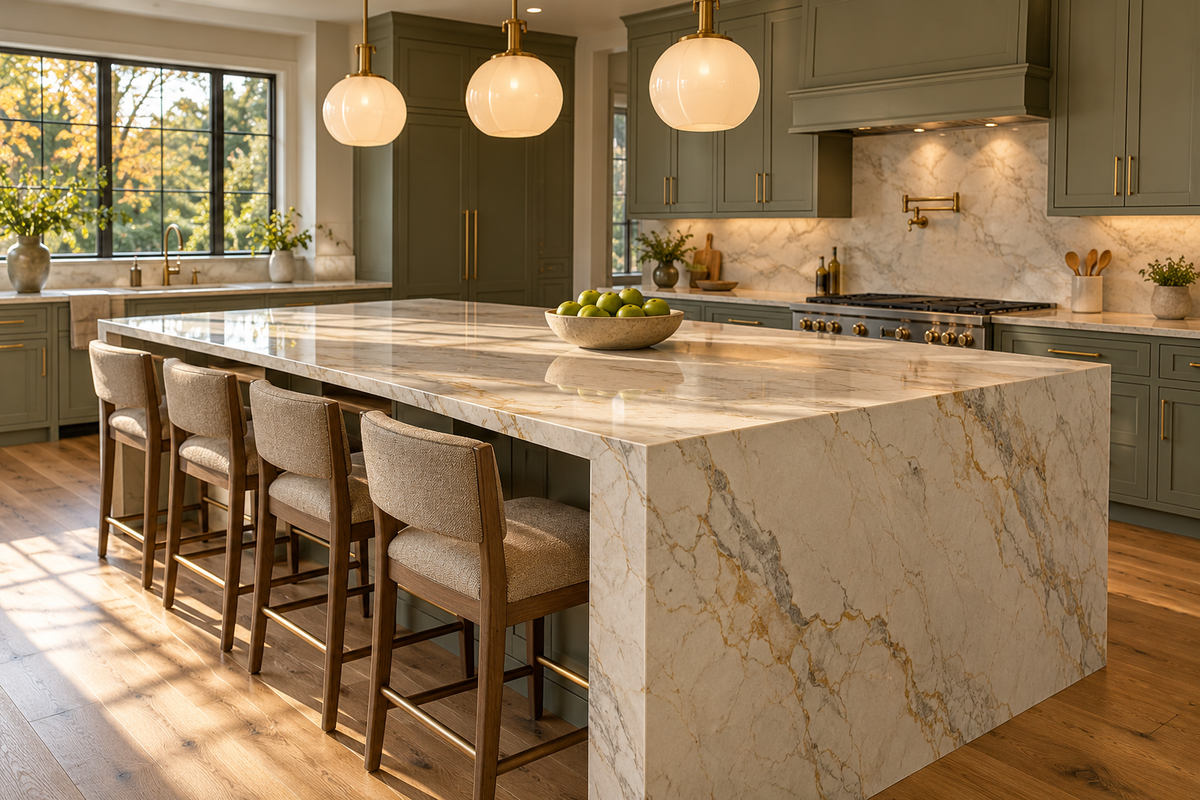
Illustration: a kitchen island with a natural stone countertop and waterfall edge.
Chantilly, Virginia, fabricator explains natural quartzite, slab identification and care for Northern Virginia kitchens and bathrooms.
CHANTILLY, VA, UNITED STATES, November 5, 2026 /EINPresswire.com/ -- Virginia Marble & Granite, an in-house countertop fabricator and installer in Chantilly, Virginia, in Fairfax County, has published a guide to quartzite countertops at https://vamginc.com/quartzite-countertops/. The guide connects the material's geology and care requirements with selecting a full slab and having it fabricated and installed. Virginia Marble & Granite (VAMG) has served Northern Virginia and the Washington metropolitan area since 2003.
The publication addresses questions that arise when similar-looking stones have different properties: how natural quartzite differs from engineered quartz and how a sample can help establish the stone's identity. Virginia Marble & Granite also explains why sealing requirements depend on the individual material. The guidance is intended for homeowners in Chantilly, Fairfax, McLean, Vienna, Great Falls and nearby Northern Virginia communities considering kitchen countertops, islands, bathroom vanities and custom applications.
Virginia Marble & Granite's guide draws on articles from Use Natural Stone, the educational and promotional campaign led by the Natural Stone Institute, an industry association. The technical references explain the stone; VAMG's accompanying process description explains how material selection leads to in-house fabrication and installation by VAMG's own crews.
Natural Quartzite and Engineered Quartz Have Different Origins
Virginia Marble & Granite's guide distinguishes natural quartzite, a rock formed from sandstone and made almost entirely of quartz, from engineered quartz, a manufactured material combining quartz particles with resin, pigments and other ingredients. The shared word describes a mineral in one context and a countertop material in another.
In Karin Kirk's 2017 article, "The Definitive Guide to Quartzite," Use Natural Stone describes quartzite as a metamorphic rock: an existing rock transformed by heat and pressure. Sand grains first become bound together as sandstone. With further burial, heat and compression, the grains fuse with their neighbors into a tightly interlocked rock. The resulting texture reflects the conditions the stone experienced underground.
Kirk's 2019 article, "Natural Quartzite and Engineered Quartz: What’s the Difference?," explains that natural quartzites contain minerals, with quartz as the main ingredient. Smaller amounts of other minerals contribute color and pattern. Some light-colored quartzites are almost pure quartz; others include minerals that produce blue tones or fine, flowing layers.
For Virginia Marble & Granite, identifying the material precedes comparing appearances. VAMG fabricates natural quartzite as well as engineered quartz from Cambria, Silestone, Caesarstone and MSI Q. A material discussion can therefore establish whether a project calls for natural rock or an engineered surface before moving to a particular slab or color.
The distinction also keeps care guidance attached to the right material. VAMG's publication treats natural quartzite as its own category and directs attention to the properties of the specific stone under consideration.
Identifying the Stone Through Its Properties
Virginia Marble & Granite's guide directs readers to the glass test described by Use Natural Stone as a way to distinguish real quartzite from marble, alongside its guidance to examine the actual slab in person. Testing adds information that a photograph or a material name cannot supply.
"Real quartzite will scratch glass easily," Kirk writes in "The Definitive Guide to Quartzite" (2017). Kirk explains that quartz is 7 on the Mohs scale, which ranks minerals by their resistance to scratching. Quartz is harder than glass and a knife blade. The article describes marble or dolomitic marble sometimes being mislabeled as quartzite; dolomitic marble is marble containing magnesium-bearing dolomite and reacts differently from quartzite.
The glass test in Kirk's article uses a rough, preferably pointed edge of a stone sample against a glass tile. After pressure is applied, the result needs examination: an actual scratch remains in the glass, while a powdered trail of stone can rub away. Kirk recommends testing different places when a sample contains visibly different minerals or colors.
For a stone without a suitable rough edge, Kirk describes a knife-blade test. Genuine quartzite is scratched lightly or not at all; marble and dolomitic marble scratch more readily. A separate test places lemon juice or vinegar on a sample for about 15 minutes, then checks for etching, a change in the surface caused by acid dissolving some of the stone. A dull patch or changed luster can reveal that reaction.
Virginia Marble & Granite's guide names the glass test and points readers to Use Natural Stone for the method; the knife and acid procedures come from Kirk's article. Kirk's later article, "A Deep Dive Into the Properties of Quartzite" (2018), adds a further distinction: sandstone can also scratch glass because it contains quartz. Texture and water absorption help distinguish a more granular sandstone from tightly fused quartzite. Taken together, the references develop the guide's emphasis on the stone's properties rather than relying on its country of origin or name.
Sealing Depends on the Individual Slab
Virginia Marble & Granite's guide explains that quartzite sealing depends on the individual stone's density and porosity and recommends discussing the specific slab, drawing on Use Natural Stone's care guidance. Porosity describes the spaces within a stone through which water or other liquids can enter.
"Depending on the density and porosity of the stone, the necessity for sealing can range from being not required at all to being required at initial installation and reapplied at specific intervals," Stephanie Vozza writes in "Caring For Quartzite Countertops" (2019), published by Use Natural Stone.
The variation follows the stone's formation. Kirk's 2018 quartzite article describes a gradual transition from sandstone through intermediate textures to highly metamorphosed, crystalline quartzite. As minerals become more tightly fused, the spaces between them decrease. The category name alone therefore does not establish how quickly a particular slab absorbs water.
Virginia Marble & Granite's publication includes Kirk's practical water test for an unsealed piece of stone. One edge sits in water for about 15 minutes. Water that wicks upward into the sample, beyond the level where it was submerged, indicates porosity. This check examines absorption, a different property from the scratch resistance assessed with glass.
For porous quartzites, Kirk's 2018 article recommends sealing worked edges and cut surfaces as well as the top. An impregnating sealer is a treatment intended to reduce liquid penetration into the stone. Attention to the edges matters because fabrication exposes additional stone surfaces. VAMG's guide uses that material guidance to frame a discussion of the particular slab's care requirements.
Vozza also identifies darkening from water around a kitchen sink as a practical sign that sealing may be needed or an existing sealer may be becoming less effective. The stone should be cleaned and allowed to dry completely before a sealer is applied. The appropriate treatment and reapplication interval depend on the material and product rather than a single schedule for all quartzite.
For everyday care, Virginia Marble & Granite's guide follows Vozza's recommendations to wipe up spills and moisture promptly and clean with a gentle cleanser, water and a soft cloth. Coasters, trivets and cooling racks protect the working surface. Cutting boards remain useful even with hard stone: the quartzite can dull a knife.
Comparing Quartzite With Granite and Marble
Virginia Marble & Granite's guide compares quartzite, granite and marble by composition, hardness and response to everyday kitchen acids. The comparison depends on the individual stone and the conditions in which it will be used.
Kirk's 2017 quartzite article explains that granite forms from magma, making it a different geological category from quartzite. Both granite and quartzite are harder than glass and resist etching from everyday kitchen acids. Strong acids, including those used in some rust-stain removers, can etch even granite and quartzite. The kitchen-acid distinction does not extend to every cleaning chemical.
The marble comparison in Virginia Marble & Granite's guide concerns a different mineral. In "Mad About Marble: A Geological Look at a Classic Stone" (2018), Kirk explains that calcite, the main mineral in conventional marble, is 3 on the Mohs scale. Knife blades can scratch it, and acids in lemonade, wine or cola can react with its surface.
Etching and staining describe different processes. Kirk's marble article explains that an acid reaction can change the color or luster of a small surface area. Sealing is typically used to reduce the likelihood of staining; it does not make marble less prone to etching. That distinction helps explain why two pale, veined materials can call for different expectations in a kitchen.
Virginia Marble & Granite fabricates all three natural stones. The guide supplies a framework for comparing them by behavior as well as appearance, while VAMG's on-staff designers help with material selection for the project.
Choosing the Full Slab in Chantilly
Virginia Marble & Granite reports in-stock slabs in over 150 colors and styles across quartzite, granite, marble and quartz at its Chantilly showroom and slab yard. A slab yard is the place where full stone slabs can be viewed and selected before fabrication. VAMG schedules visits by appointment.
The full slab shows the scale and direction of a pattern across the actual material. Virginia Marble & Granite's About page explains that seeing it reveals a color range and pattern that a small sample cannot show. The quartzite guide puts the same point in the company's own words: "To judge the color and veining of a slab, see it in person at our showroom and slab yard in Chantilly." For an island or a long kitchen counter, that broader view brings the chosen stone's appearance into the same discussion as the planned countertop dimensions.
Taj Mahal quartzite is one example in VAMG's guide and color catalog. Kirk's 2017 article describes Taj Mahal among quartzites that have undergone extensive metamorphism, with minerals tightly bonded together. The example illustrates why quartzites can differ in porosity; it is not a substitute for examining a particular slab.
Virginia Marble & Granite's quartzite color catalog is available at vamginc.com/quartzite-countertop-colors/. The guide also presents examples ranging from cream-white and soft gray to blue-gray bands and near-black stone with white veins. Those images provide a starting point for discussing color, followed by in-person selection of the real slab at VAMG's Chantilly location.
"The slab selected at Virginia Marble & Granite is the slab VAMG fabricates in-house and installs with its own crews," Virginia Marble & Granite says. That continuity connects the material-selection discussion with the company responsible for cutting and installing the countertop.
From a Cabinet Sketch to an Installed Countertop
Virginia Marble & Granite's guide and its process description set out the stages between choosing the material at the Chantilly showroom and slab yard and completing installation.
The initial estimate begins with a blueprint, drawing or hand sketch of the cabinets with dimensions. Virginia Marble & Granite uses that information to prepare a quote. The drawing communicates the project at the planning stage; exact measurements are taken in the templating stage after the quote is agreed.
Templating establishes the measurements used to fabricate the countertop. Virginia Marble & Granite sends a template technician to take those exact measurements at the project location. VAMG identifies laser templating among its fabrication capabilities, along with robot technology. The guide places these capabilities within the company's in-house process.
After the measurements and stone selection are complete, Virginia Marble & Granite brings the material into its fabrication facility. Measurements are entered into a computerized system, and the stone and edge profiles are cut to those measurements. Edge profiles are the shaped outlines along the countertop's exposed edges. VAMG's own crews then install the finished countertops.
Virginia Marble & Granite sources marble, granite and quartzite directly from quarries including those in Brazil, Italy and India. The company identifies quartzite as an important line, particularly for higher-end residential kitchens and bathrooms. VAMG fabricates it for kitchen countertops, islands, bathroom vanities and custom applications, with on-staff designers assisting in material selection.
The company serves Chantilly, Fairfax, McLean, Vienna, Great Falls and nearby Northern Virginia communities. Virginia Marble & Granite's guide brings the technical material questions and the local fabrication process into one publication, with the original guidance available online and full-slab viewing available by appointment at the Chantilly showroom and slab yard.
About Virginia Marble & Granite
Virginia Marble & Granite Inc. (VAMG) is a countertop fabricator and installer in Chantilly, Virginia (Fairfax County), serving Northern Virginia and the DMV area since 2003. DMV refers to Washington, D.C., Maryland and Virginia. VAMG fabricates granite, quartzite, marble and engineered quartz from Cambria, Silestone, Caesarstone and MSI Q in-house and installs them with its own crews. Customers choose their slab at the showroom and slab yard, 3933 Avion Park Ct Suite #B110, Chantilly, VA 20151. Visits are by appointment. VAMG is licensed, insured and bonded and provides a 1-year limited warranty for labor and maintenance. Phone: 703.378.5533. Website: vamginc.com.
Press
Virginia Marble & Granite
703.378.5533
Legal Disclaimer:
EIN Presswire provides this news content "as is" without warranty of any kind. We do not accept any responsibility or liability for the accuracy, content, images, videos, licenses, completeness, legality, or reliability of the information contained in this article. If you have any complaints or copyright issues related to this article, kindly contact the author above.
